About Khaled Sayed

Showing posts with label Middle East. Show all posts

Monday, June 30, 2014

June 30th First Anniversary


June 30th, 2013 is the day Egyptians decided to act on their Rebel campaign threats. Millions of Egyptians took to the streets of Cairo and many other cities in Egypt to protest against the Muslim Brotherhood ruling and against president Mohamed Morsi.


Walking among the protesters on that day, and overhearing their concerns and disapproval of how Morsi was running the country, gave me hope that change was about to happen. A year later, Morsi's regime has ended, but Egyptians' problems and concerns have not been solved. They are still having gas and electric shortages, a bad economy, inflation, a corrupt government and the garbage issue that is always staring them in the face.


The only difference now is that Egyptians have another president with a regime that won’t allow their citizens freedom of speech, or freedom to protest or complain. So far the Sisi regime is doing a great job of handing out mass sentences to activists and journalists, and of course death sentences to all Muslim Brotherhood supporters and leaders, regardless to their age or affiliations.


The same problems in Egypt that were the main reasons behind the ousting of Mubarak and Morsi still exist for Sisi to deal with. These issues won’t just go away simply because a new president was elected, no matter how you feel about his election.


Egypt's problems won’t go away just because of who is in charge. They are big issues and they need the whole country to come together to face these issues, with a very smart leader to lead. People in Egypt, like people in other countries, want to think that an election is the solution. But although an election is a good way to elect smart leaders who could find ways to solve social and economic issues, no issues will just disappear upon electing one person.


The revolution that started in January of 2011, and the second one in June of 2013, only helped us to remove leaders, not the underlying military regime that has been in power all along. The corrupt regime that Nasser, Sadat and Mubarak helped to build and nourish is what we need to change, and what we need to overcome.


We won’t be able to get rid of the corruption without raising awareness and giving everyone a good education, for old and new generations alike. We need a modern education to help us to listen and respect each other's views, and teach us to voice our opinions in a such a way that we all get heard and acknowledged.


We also need to create a political system that works for us; not copy other people. We need human rights laws and freedom of speech. We need to learn to be selfless and take care of each other, and above all take care of our country and love it.

The question is, when Sisi's government fails to fix Egypt's real problems, will the Egyptian people be able to take to the streets again to protest against the failure of Sisi’s regime, or will military rule prevent that from happening?

Wednesday, May 28, 2014

The Democratic Election Illusion.


You can say many things about Egyptian politics but calling it unpredictable isn’t one of them. Since the first time we had so called democratic and free elections, we always knew who would win, and the 2014 presidential election is no different.
Many Egyptians can’t help feeling like one candidate is the winner this year and that feeling is not new at all. In the Egyptian presidential election of 2012, after our amazing revolution in 2011, we were rushed into an election that forced us to vote for the Muslim Brotherhood puppet “Mohamed Morsi”.
Morsi’s campaign was like a flood that swept Egypt; banners covering buildings, posters everywhere, and he was on TV more than any of his opponents. Morsi’s image was blasted all over the place, and Egyptians were sold on the change he would bring to Egypt. Little did we know it was more of the same.
This time around we have two candidates, but you hardly can see anyone else next to the former army chief Abdel Fattah al-Sisi. Like Morsi, his images are on the buildings, his banners are in the streets, and he is all over the TV.  We’re seeing Sisi giving interviews all over, but Sisi’s rival, leftist candidate Hamdeen Sabahi, is hardly visible.
With headlines like “Sisi Set for a Landslide Win After Egypt Presidential Election Ends,“  and another headline reading, “ A Landslide Victory for Ex-Army Chief Abdel-Fattah el-Sissi is widely expected” leading into the election, it is obvious who everyone believes is going to win.
Many Egyptians are not participating in this election because they feel it is not a fair nor democratic election. But people are not allowed to voice their disagreement with the way this election has been run. Furthermore they are not allowed to protest peacefully in the street. The new anti-demonstration law that was passed this year by the acting interim president left many people in jail awaiting trials, and scared the rest of the Egyptians from protesting.
The overwhelming sentiment is: if you don’t vote for Sisi you are a traitor and you are against the army. With an atmosphere like that, people can’t help but to reman in silence. Activists are pressured to keep their opinions to themselves.
Away from all the campaign and election fuss, many poor people in Egypt don’t care one way or another. After a few years of chaos and clashes, the poor people are still suffering and their situation hasn’t improved, but rather declined. Over a quarter of Egyptians live under the poverty line.
Whoever wins the election, to many people it won’t change much. Knowing who will win an election before it happens takes all its legitimacy away, and makes it far from a democratic process. For now we are jus worried that Sisi will set Egypt back to an old repressive regime that Egyptians are very familiar with when he wins, which, of course, he will.


Saturday, May 10, 2014

Abdel Fattah El-Sisi for President?


With a high approval rating, many Egyptians think that Abdel Fattah El-Sisi is the answer to all the country’s problems. and they saying that  he is the hero God sent to make everything right again -- until he opened his mouth during an interview, which was aired in two parts, on a private Egyptian channel.

The TV interview with sisi last week revealed an out of touch military man with has no answers or understanding of how bad things are in Egypt. It also showed that he is not prepared to be the leader everyone desperately wants him to be.

His answer to a debilitating economy and high unemployment is to create trucks out of thin air and hand them over to young men to use as mobile vegetable shops. When he was asked where the trucks are coming from, Sisi said "don't worry they will be here if I say so" with the attitude of a high school bully.

When Siai was pressed to further explain his solution to the unemployment issue, he mention something about telling the banks to buy the trucks and then the drivers would be responsible for repaying the loans when they started making money.

It was clear that he had been put on the spot, He didn’t have prepared answers. However these questions should have been thought of before he ever agreed to be on the interview. Mind you that these questions are on mind of everyone in Egypt: What are you going to do about the economy? How can you solve the unemployment problems? education? corruptions? all of this are questions that need to be answered by someone who is running for president.

Sisi also promised that he will eliminate the Muslim Brotherhood from the political stage in Egypt. His language insinuated that he is going to remove them by any means necessary.

Now Egypt is faced with an unqualified front runner for president. He is a military man who thinks that he can create things out of thin air, and eliminate his opponents by any means necessary.

Unfortunately Sisi will win and the struggle will continue to find someone better to lead Egypt out of the dark ages.

Wednesday, December 25, 2013

Former PM Hisham Kandil Latest Muslim Brotherhood Member Captured


Authorities in Egypt have arrested the ousted President Morsi’s Prime Minister, Hisham Kandil. Kandil was caught in the southeast mountain area with smugglers while he  was trying to cross the border to Sudan. His arrest came as no surprise since the Egyptian authorities have been hunting down all prominent members of the Muslim Brotherhood and Morsi’s cabinet.


I have been asked time and time again about what is going on in Egypt since I spent six month there this year. Unfortunately my explanation sounds more like fiction, but it seems very obvious to me.


The Muslim brotherhood, who lived in the shadows for years, came out of hiding after the initial revolution that removed Mubarak in 2011. It was a great opportunity for them to replace  Mubarak and capitalize on the revolution. The reason why the Egyptian Military and secret services have been very successful in capturing Brotherhood members is because the Brotherhood felt very comfortable after Mubarak’s fall.


After all, the Brotherhood went through a parliamentary election and won 60% of the seats in 2011, and followed that by nominating an unknown person, Morsi, for the presidency. Getting Morsi a majority of the popular vote must have been a very comforting ego boost to the Brotherhood.


With all the winning in 2011 and 2012, the Brotherhood must have felt as if they were free at last, after 60 years of hiding. The Muslim Brotherhood had attracted more people by proving themselves legitimate after winning a majority and installing Morsi as the president.


In 2013 the Muslim Brotherhood were unstoppable. They became the mainstream, and gained street credibility. However they underestimated the Military, who were watching and quietly doing what they do best; creating a list of all the Muslim Brotherhood members. So when the military answered the people’s call for removing Morsi on July third, they were also ready to dismantle the Brotherhood soon after.


So If you want to know what is going on in Egypt, keep an eye on the military, because they are the ones with the guns, and they have the most to gain or lose if the economy goes bust.


When you hear that the authorities arrested another Brotherhood member, it shouldn’t be a surprise. It is a round-up that the military is doing to secure the country, but mostly to secure their interests and stay relevant.

Wednesday, December 4, 2013

New Anti-Protest Law Backlash


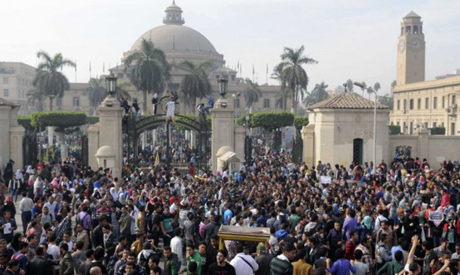
The new anti-protest law backlash is giving pro-Morsi protesters a reason to start taking to the street again, this time in universities all over Egypt.

In recent weeks in the light of new anti protest law, many activists have called for a demonstration to express their discontent with the new law. Twenty-seven women and men who took part in a demonstration outside the upper house of parliament were arrested. They were later released in the middle of the desert outside Cairo. These protests are not against the government per-se: they are against the new law.

On the other hand, there are opportunists who are against the government and want to re-install the ousted Islamist president Morsi. These are mostly Egyptians who oppose the interim government backed by army chief General Abdel Fattah al-Sisi. They identify themselves by carrying banners that say, “Sisi is a murderer,” or they display a symbol of four fingers, which was adopted by Morsi’s Muslim Brotherhood supporters after July, 2013.

These are the major players on the protest stage right now; one side calling for freedom from government regulations, and the other side is calling for Morsi to return to the presidency. In hopes of finding a new audience to their cause, the pro-Morsi have been protesting in universities all over Egypt.

In November the cabinet issued a decision allowing police to enter university campuses without prior permission if facilities or students were under threat. Previously, police had been banned from campuses unless specifically invited by university authorities.

If this law passes we will have both groups fighting each other in the street and at universities. This would make the situation more confusing and it will be interesting to see what would happen next.

Sunday, November 17, 2013

Calls to Commemorate Mohamed Mahmoud


Two years ago in Cairo, in November of 2011, I participated in a huge march from the Haram, in the Giza area, which is a suburb of Cairo, all the way to Tahrir Square: probably about nine miles. Here, ten months earlier, the revolution had emerged to remove Hosni Mubarak from power.


I was filming and photographing the crowd as it grew larger and larger, every block we walked, every neighbourhood we crossed. There are no words that could express my feelings on that day. Egyptians mobilizing and organizing to call on the Supreme Council of the Armed Forces (SCAF) to stop the violence, and  make the demands of the revolution come to life.


Many of the protesters knew that the SCAF could attack them. The previous month the SCAF had carried out an attack on peaceful protesters in front of the Egyptian State TV building. The attack resulted in the deaths of several protesters and wounding of many others. But that didn’t stop the protesters from participating this day.


Happily no violence took place.  However the following day in the late afternoon the state police attacked a group of Occupy Tahrir protesters, who were determined to stay till their demands were met. Most of those were wounded people from the revolution, and families of people who lost their loved ones during the revolution and other clashes that followed.

The state police attacked the peaceful protesters who were camping in Tahrir, and killed five people within half an hour. The attack was not anticipated by the protesters. In no time, the word got out through social media and cell phones about what was happening in Tahrir. The activists responded right away to defend the Occupy Tahrir people. After a few hours they managed to force the state police to retreat to their headquarters a few blocks away.

What stood out in my memory is that the protesters asked for help from the Muslim Brotherhood and the Salafis, and both groups declined to lend a hand, probably out of fear of losing in the upcoming parliamentary election.

These attacks sparked the week-long Mohamed Mahmoud clashes. I’m proud that i was there to document what happened. Here is some of the video that I shot during the clashes.


Mohamed Mahmoud clashes in NOV 2011 from Khaled Sayed on Vimeo.

Saturday, November 2, 2013

No End to Islamist Violence in Sight


Even though the Muslim Brotherhood leaders are losing ground and Egyptian public support, they are still insisting on unrealistic demands. While they have no upper hands, the Muslim Brotherhood are demanding to sack military leaders, reinstate the deposed president Morsi, and restore the constitution Morsi pushed through.

While the Muslim Brotherhood trying to send a message to the world that they won’t accept what they call a military coup that ousted Morsi, they are paying a high price in human lives that they lose every time they take their show of support for Morsi to the street.

Eager to take over Egypt's political scene after the toppling of Mubarak in the January 25 popular uprising, the Muslim Brotherhood did everything they could to lead the country. Their political party, Freedom and Justice, was a brand new front for the Muslim Brotherhood that won the majority in the parliament in 2012, followed by electing a Muslim Brotherhood president who has been unknown to most Egyptians until right before the election.

With all these successes under their belt, the Muslim brotherhood didn’t care about the Egyptian people's security, economy, or the demands they made during the 2011 revolution. Morsi was only interested in what the Muslim Brotherhood's supreme guide, Mohamed Badie, advised him to do every step of the way during his short-lived one year presidency.

Although Morsi was very popular among his party and group members, he wasn’t very popular on the street. People mocked Morsi and made fun of his many gaffes on Egyptian TV and during his trips to other country.

The Muslim Brotherhood is continuing to defy the military. However the crackdown is targeting the top heads of the Muslim Brotherhood organisation and prominent members. One of the latest arrests was the Senior Muslim Brotherhood deputy leader Essam el-Erian. He was arrested in a Cairo suburb in late October. Today thousands of Morsi supporters demonstrated nationwide on Friday against the military-backed government ahead of his planned trial on Nov. 4.

Mohamed Morsi, who was removed from the presidency by the military amid nationwide protests against him is still in custody and accused of many crimes, such as inciting violence and of failing to protect protesters who were killed outside the presidential palace in El-Etahadya.

The Muslim Brotherhood rallies people to go out and protest and sacrifice themselves for the selfish goals of increasing the group's own political power, and restoring their control over Egypt again. However I think Egyptian people are becoming smarter every day, and with no end to Islamist violence in sight, Egyptians are getting more familiar with Muslim brotherhood rhetoric, and their truly violent nature.

Wednesday, September 18, 2013

Why We Shouldn't Strike Syria


If you agree with the US strike on Syria as a way to save Syria and support the Syrian people, you have to ask a very important question: Is Iraq better off today than before the US invasion?

To answer this question we have to examine the facts. Since the US invasion in Iraq, the documented civilian deaths from violence have been 114,406 – 125,376. Yes the US did manage to remove Saddam, but the country is divided more than ever. The violence increased since the invasion, and if you ask most Iraqis, they would have much preferred Sadaam to the mess that they are in right now.

Is dictatorship is bad? Yes, of course it is bad. But we have to take a hard look at what kind of positive gains the Iraqis have realized after removing Saddam.

Syria has many issues, but a US air strike won't fix these problems and removing Assad because the US thinks that he used chemical weapons on his own people is not a proven reason. It has been common knowledge that many videos have surfaced online with rebels admitting using they used the chemical weapons that were found to have been used in Syria by mistake, and confirming that they got the weapons from Saudi Arabia and Qatar. However the US chooses to ignore that possibility, and build a case to justify the strike on Syria. It feels awfully similar to the way George W. Bush justified the Iraq war after the 9/11 attack, which Saddam had nothing to do with it.

The idea of an air strike on Syria isn't about helping the Syrian people. If it were, the US would have intervened when the Syrian civil war started in 2011. But the current strike is simply about the US and its own interests. If the US cared about people who get attacked with chemical weapons, we have to ask why didn’t they respond when Israel used white phosphorus in Gaza civilian areas?

The likely reason that the US didn’t comment on the Israeli attacks is because in 2004 the US used the same chemicals in civilian areas in Fallujah, Iraq. Both the US and Israel made the same claim; that white phosphorus was not being used as a chemical weapon, but only, "to create smokescreens or illuminate targets." Additionally, the US government supplied Israel with the white phosphorus which was used in the attack.

We can also go back to the Reagan era, when the White House looked the other way as chemical weapons were used in the Iran Iraq war the 1980s. More than a million people were killed on both sides of the of the conflict under the watch of the US.  

Recently declassified documents from that time indicate that not only did the US government know that Saddam had these weapons, but “conveyed the location of the Iranian troops to Iraq, fully aware that Saddam’s military would attack with chemical weapons, including sarin gas.”

President Reagan also remained silent during the Al-Anfal campaign, in which Saddam used poison gas against the Kurdish population in Northern Iraq to put down a revolt against his rule. In what has later been called a genocide, more than 100,000 men, women, and children were killed; nearly 100 times more than in the attack that took place outside of Damascus last month.

Given US history, I’m not sure why they care to go after Assad for using chemical weapons. They must have a another reason. The civil war in Syria has been going on for two years, and Assad has committed terrible war crimes, including bombing civilians and targeting specific religious groups. The death toll over the two years is very high. If the US is going after him because the use of chemical weapons is a red line, it is a poor reason.

If the US is against the use of chemical weapons, they need to start here at home, by banning all chemical weapons production, and making It illegal for American companies to produce and sell them, nationally or internationally. The US also needs to destroy the chemical weapons the already have, to set an example.

The bottom line is that the Iraqi people aren’t better off because of the Iraq war. They are in a worse situation since the US invasion. The country can’t recover, the civil war there has not stopped, and the terror attacks are happening systematically, with no end in sight.

Friday, June 28, 2013

Morsi Reads from Mubarak's Script


Two years after the initial revolution, Morsi warns of risks from unrest, just like Mubarak did in January 2011. Trying to gain the people's support, Morsi's three-hour speech did nothing but anger people.
During the start of the revolution, before he left office, Mubarak gave a speech that tried to play on people's feeling and get them on his side. It only took him ten minutes to do that, and he divided the the Egyptian people, getting a large number of Egyptians wanting him to stay in office.
It took Morsi three hours to do the same thing; now many people on the streets of Cairo are wishing Mubarak would come back.
From standing in the middle of Tahrir square with thousands of protesters on June 26, during Morsi's speech, I am feeling the frustration and anger of the Egyptian people. After a long speech, Morsi only proved that he is is removed from the reality on the street, and completely unaware of how people suffer or feel. Unfortunately, Morsi speech didn’t not offer any concessions or suggestions of improvements. All his speech did was try to gain police and army supports in upcoming days, as the country braces for the June 30 Rebel protests.
Morsi threatened the opposition and media many times during his long speech. Morsi also accused several judges – by name – of corruption. He asked pointed questions about how Mubarak-era figures had been acquitted by Egypt's court system. Morsi spoke about pseudo-achievements that did not happen during his term. He was delusional to the point of  accusing the people themselves of being responsible for all of Egypt's issues and crises, and blaming them for all the recent political problems.
Morsi failed to take any responsibility for the country's deep political polarization and failed economy. Instead he  blamed all former presidents for all economic and political issues that Egypt faces today.
It's awkward and telling that Morsi of used many of  the same words and phrases that the ousted president ,Hosni Mubarak, often used. Morsi appeared to be speaking about another Egypt, one that does not exist in the real word.
The Egyptian military has moved forces near Egypt's major cities, openly threatening to intervene if Morsi's supporters and opponents cannot find a compromise and avoid bloodshed. The stage is set, as the military seems to be siding with the people against the Islamists who support the Morsi regime.
I do feel like the upcoming days won’t pass by without significant clashes between the Muslim Brotherhood and the rest of the Egyptian people.