About Khaled Sayed

Showing posts with label anti-demonstration law. Show all posts

Monday, June 30, 2014

June 30th First Anniversary


June 30th, 2013 is the day Egyptians decided to act on their Rebel campaign threats. Millions of Egyptians took to the streets of Cairo and many other cities in Egypt to protest against the Muslim Brotherhood ruling and against president Mohamed Morsi.


Walking among the protesters on that day, and overhearing their concerns and disapproval of how Morsi was running the country, gave me hope that change was about to happen. A year later, Morsi's regime has ended, but Egyptians' problems and concerns have not been solved. They are still having gas and electric shortages, a bad economy, inflation, a corrupt government and the garbage issue that is always staring them in the face.


The only difference now is that Egyptians have another president with a regime that won’t allow their citizens freedom of speech, or freedom to protest or complain. So far the Sisi regime is doing a great job of handing out mass sentences to activists and journalists, and of course death sentences to all Muslim Brotherhood supporters and leaders, regardless to their age or affiliations.


The same problems in Egypt that were the main reasons behind the ousting of Mubarak and Morsi still exist for Sisi to deal with. These issues won’t just go away simply because a new president was elected, no matter how you feel about his election.


Egypt's problems won’t go away just because of who is in charge. They are big issues and they need the whole country to come together to face these issues, with a very smart leader to lead. People in Egypt, like people in other countries, want to think that an election is the solution. But although an election is a good way to elect smart leaders who could find ways to solve social and economic issues, no issues will just disappear upon electing one person.


The revolution that started in January of 2011, and the second one in June of 2013, only helped us to remove leaders, not the underlying military regime that has been in power all along. The corrupt regime that Nasser, Sadat and Mubarak helped to build and nourish is what we need to change, and what we need to overcome.


We won’t be able to get rid of the corruption without raising awareness and giving everyone a good education, for old and new generations alike. We need a modern education to help us to listen and respect each other's views, and teach us to voice our opinions in a such a way that we all get heard and acknowledged.


We also need to create a political system that works for us; not copy other people. We need human rights laws and freedom of speech. We need to learn to be selfless and take care of each other, and above all take care of our country and love it.

The question is, when Sisi's government fails to fix Egypt's real problems, will the Egyptian people be able to take to the streets again to protest against the failure of Sisi’s regime, or will military rule prevent that from happening?

Friday, May 16, 2014

The Egyptian Presidential Election 2014


The Egyptian presidential election this time is between former army chief Abdel-Fattah El-Sisi and longtime Nasserist politician Hamdeen Sabahi, who finished third in Egypt's 2012 presidential poll.

Egyptians living overseas started lining up to vote in the presidential election, but many are boycotting the presidential election altogether. I’m one of these people.

The decision to boycott the presidential election very much depends on whom you ask. People from the  Muslim Brotherhood who support Morsi believe that his ousting was a coup, and they still believe that Morsi is the president of Egypt.

On the other hand most activists don't see that the election is going to change much in Egyptian politics. It is just an election like other elections we have had since the removal of Mubarak in 2011. This election is designed to give control to another ex-military man who believes that freedom of speech is not necessary right now, and it might hurt the country.

However I boycott the election because I don’t see any sign of change. I also think that this election is forcing every Egyptian to choose between the bad and the worst; by the worst I mean former army chief Abdel-Fattah El-Sisi.

I know that sometimes you don’t get what you want, but we have been getting the bad end of the bargain all the time. Therefore we have to demand change and we have to get our voices heard.

People didn’t sacrificed their lives during the uprising so former army chief Abdel-Fattah El-Sisi could become the president of Egypt. They lost their life seeking change and democracy. However we are too far away from that goal.

Wednesday, December 4, 2013

New Anti-Protest Law Backlash


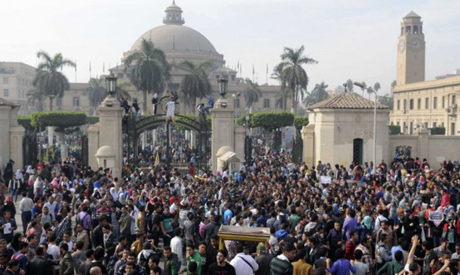
The new anti-protest law backlash is giving pro-Morsi protesters a reason to start taking to the street again, this time in universities all over Egypt.

In recent weeks in the light of new anti protest law, many activists have called for a demonstration to express their discontent with the new law. Twenty-seven women and men who took part in a demonstration outside the upper house of parliament were arrested. They were later released in the middle of the desert outside Cairo. These protests are not against the government per-se: they are against the new law.

On the other hand, there are opportunists who are against the government and want to re-install the ousted Islamist president Morsi. These are mostly Egyptians who oppose the interim government backed by army chief General Abdel Fattah al-Sisi. They identify themselves by carrying banners that say, “Sisi is a murderer,” or they display a symbol of four fingers, which was adopted by Morsi’s Muslim Brotherhood supporters after July, 2013.

These are the major players on the protest stage right now; one side calling for freedom from government regulations, and the other side is calling for Morsi to return to the presidency. In hopes of finding a new audience to their cause, the pro-Morsi have been protesting in universities all over Egypt.

In November the cabinet issued a decision allowing police to enter university campuses without prior permission if facilities or students were under threat. Previously, police had been banned from campuses unless specifically invited by university authorities.

If this law passes we will have both groups fighting each other in the street and at universities. This would make the situation more confusing and it will be interesting to see what would happen next.

Wednesday, November 27, 2013

Prosecutors Order the Arrest of Egyptian Activists


If you thought the Egyptian revolution has changed anything about Egyptian politics, you are sorely mistaken. Prosecutors have been ordering arrests of prominent Egyptian activists who were protesting outside of the high court in response to the new demonstration law. The new law, which was signed by the interim president Adly Mansour, bans street protests.

Under the new law, Egyptian police are allowed to use force to disperse demonstrators. In addition captured demonstrators could be sentenced to prison for as long as seven years for the use of violence at a protest, one year for covering their faces during a protest, or one year for protesting outside a place of worship. Furthermore, anyone attending an unauthorised protest can be fined up to $1,500. The new law targets public gatherings of ten people or more without government approval.
In order to avoid imprisonment or a fine, you should notify the authorities that you will be protesting three days before the protest takes place.

After arresting 15 women and 12 men who took part in the demonstration outside the upper house of parliament, they were released in the middle of the night on a desert road about 6 miles south of Cairo.

Whoever crafted that law obviously knows very little about Egyptians. I have attended many protests in Egypt, and one thing I have noticed about the crowd is that it is a fierce crowd. They do not fear water cannons, tear gas, or even bullets. A law like this will not stop the people from taking to the street to protest.

I believe that what the interim government is doing is paying much more attention to activists than the bad economy, the poor people, and the failing education system.

The government is ignoring the main reasons why activists call for protests. These reasons have not changed since before the removal of Mubarak in 2011. The terrible living situation is due to the lack of security, the lack of employment for young people, and the inflation that is a burden on all Egyptians. These issues won’t go away without the Egyptian government actively fixing them, and listening to their people’s demands. There will be no need to demonstrate, or for a law against demonstrations, if the government does its job.


The recent arrest and the new anti-demonstration law are tools to repress the Egyptian people, but that tactic didn’t work for either Hosni Mubarak who was removed in January, 2011, nor Mohamed Morsi who was removed in July, 2013, both by the will of the people.


Article 73: Citizens have the right to hold general meetings, marches or protests, or any form of peaceful protest, without carrying any weapon and upon notifying the authorities of planned demonstrations in accordance with the law.